
The sound of harp music fills the Quebec home of music technology professor Aaron Liu-Rosenbaum as he explains his quietly radical approach to analysing the music of Led Zeppelin.
Liu-Rosenbaum’s wife, the harp player Yvonne Liu, is practising in another room ahead of a performance the following day. It’s a fitting background to Liu-Rosenbaum’s discussion of how he has spent more than 20 years analysing the sound, lyrics and packaging of Led Zeppelin’s discography.
Liu-Rosenbaum’s research began around 2002 when he began researching what he calls the “sonic narrative” of Led Zeppelin’s music. That resulted in his 2009 dissertation in which he published perhaps the most extensive analysis yet of “When the Levee Breaks” and “Stairway to Heaven”.
“That basically was the launchpad for my academic career,” he explains in a video call with LedZepNews.
A trained classical composer, heavy metal guitarist and professional audio engineer, Liu-Rosenbaum’s approach sees him discuss every element of Led Zeppelin’s music in forensic detail, rooted in music theory.
“I wanted to apply that kind of rigour to their music to try to understand why I liked it so much, because we were used to doing that with classical pieces,” he explains.
“A lot of the time you never really get to the why of it. You talk about chords and rhythms and melodies and motifs and you can parse things into different pieces. But I’m really interested in the emotion,” he adds.
Now, he’s written an upcoming book, provisionally titled “Epic: Sonic Narrative in Led Zeppelin”, which uses the latest academic approaches to consider how Led Zeppelin’s music is able to generate an emotional response in listeners.
In the 288-page book, which will be published by Bloomsbury Publishing on April 1, Liu-Rosenbaum discusses what he calls “the heroic quest for wisdom”, something he believes is a narrative present throughout the band’s discography.
“The lyrics of ‘Stairway to Heaven’ suggest something like that,” he explains. “But also there’s a sense of journeying, of wandering but also of seeking that I got through several Led Zeppelin songs.”
“Even in songs that I didn’t write about, ‘We come from the land of the ice and snow’, there’s this sense of travel. And travel also has an association of learning,” he adds.
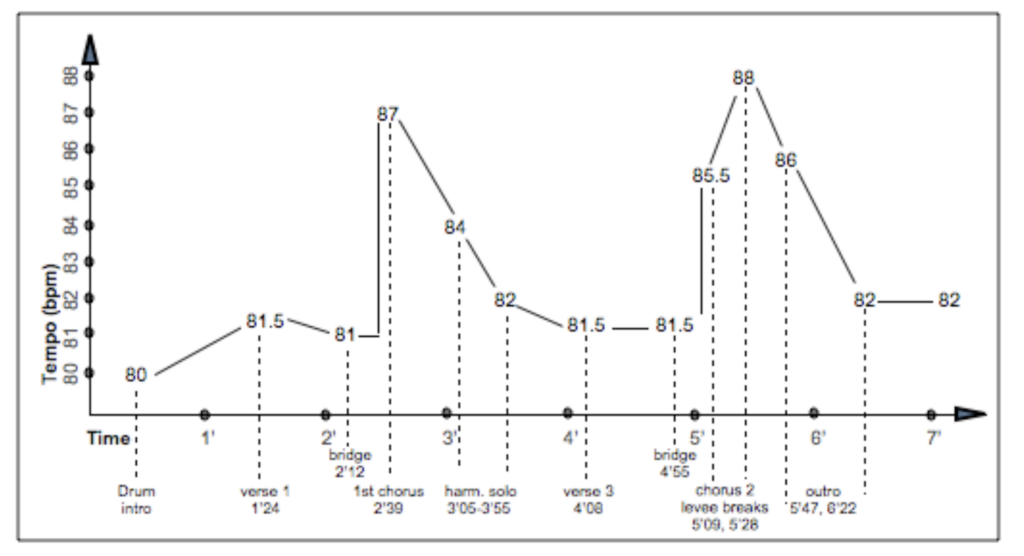
Liu-Rosenbaum’s work is an exhaustive exploration of Led Zeppelin’s music, covering everything from the tempo of the instruments and pitch of the vocals to the stereo placement of different sounds.
He hopes his book will be accessible to people outside of the realm of academic study of music. “I said to myself, I’m not going to do just a textbook. I did not want it to be a dry kind of purely analytical book,” he explains. “I made it so that it really skirts the line between textbook and fan book, because I’m a fan.”
Throughout his work, Liu-Rosenbaum closely analyses the lyrics of Led Zeppelin’s catalogue, a topic he calls “underestimated and underappreciated.”
“We really should pay attention to the lyrics,” he says. “I had come across some things in the literature where the lyrics are discounted: ‘It’s just the screaming and the sex and whatnot.’”
“But no, they wouldn’t have gone as far as they did if it were just that. It has to be something more of a spiritual level. And I, of course, knew a little bit about Page’s interest in the esoteric, but I didn’t see it as a negative thing. I just saw it as another dimension to their music.”
While other Led Zeppelin books delight in drawing tenuous links between the band’s music and Jimmy Page’s interest in the occult, Liu-Rosenbaum sticks to analysing what we actually know.
“I didn’t want the book to be another one of those ‘let’s try to find this evil subtext’,” he says. “There’s enough of that. And frankly, the music never affected me that way. It lifted me up. And that’s what I wanted to communicate to people.”
Being a trained audio engineer, Liu-Rosenbaum also spends significant time analysing Led Zeppelin’s studio methods.
“I think that’s maybe just second to the music itself,” he says. “The way Page put his hand in the production process clearly guided the songs to some really interesting sounds.”
As an example, he cites the technique in “Achilles Last Stand” where Robert Plant’s vocals are doubled in alternate phrases in the song’s verses.
“These are techniques that are compositional,” Liu-Rosenbaum says. “That’s basically composing with texture and timbre. Without that, the music would lose an entire dimension of meaning.”
Led Zeppelin’s studio innovation is a topic that he believes has often been overlooked. “One thing about Page and the band in general, they were really creative,” he says.
“When you talk about like progressive rock, people talk about Yes and other groups like that. But I think Zeppelin was really progressive when it came to production.”
As well as analysing the sound of Led Zeppelin, Liu-Rosenbaum also considers the band’s album art in his work. It’s an approach he’s nervous about.
“I wasn’t sure how people would take that, actually. Sometimes I’m still afraid because the book hasn’t come out yet. It’s not finished, it hasn’t gone through the proofing stages,” he says. “So I wonder if they’re going to call me a quack. Everybody has their little insecurities.”
But the combination of the music and the artwork often helps to explain the meaning of the band’s work.
“The image inside LZIV, you have to take that into account because that alone hits you when you see it,” he says. “Even if you don’t understand any of the lyrics, [or understand] just a few of them, they go deep.”
“They hit you in a very kind of deep psychological part of you. And when you look at the image with the lyrics, I knew that there was a power there. And I just wanted to try to accurately describe what I was experiencing. And if it resonates with other people, so be it. And if not, also, then I’ll just go out on a limb.”
The approach of combining analysis of the music and artwork is one that is becoming increasingly popular. “This kind of polysensory musical experience is starting to make its way through academia. People are starting to look at all the senses when it comes to experiencing music,” Liu-Rosenbaum says.
Liu-Rosenbaum says his book references the ongoing debate around the appropriation of black music by white groups like Led Zeppelin, but it isn’t a topic he covers in detail.
“When I was listening, actually, I was asking myself if I was going to talk about this question,” he says. “I was listening to some blues artists and I realised, ‘hey, wait, this blues artist copied that blues artist, and that blues artist copied that blues artist, and then you have Led Zeppelin.’”
“So you have a whole chain, a succession of borrowing. And it is part of the tradition. I’m not making an excuse for those who borrow without permission and without credit, obviously,” he continues. “But I think that there needs to be a counterbalance to and a greater contextualisation of the question before we can really judge people so harshly.”
After spending more than 20 years researching the music of Led Zeppelin, what might Liu-Rosenbaum have spotted that others have missed?
“It’s presumptuous of me to say because I’ve probably missed things that you all have heard,” he says. “In general, we have a tendency to listen to rock and metal music and oversimplify it. People would say, ‘Oh well it’s just distortion. That’s why it’s powerful.’ Or ‘The lyrics are vague enough so everybody can associate to something in them.’”
“But there’s a lot of nuance in the sound. A tremendous amount of nuance. Details that are definitely the result of intensive studio work,” he says. “I know because I am trained as an audio engineer in addition to being trained as a composer. And I worked as an audio engineer. So that gave me the tools to listen to this music from an audio engineer’s ears.”
“When I first studied the mix to ‘When the Levee Breaks’ and I wrote it down on paper, I beheld in front of me the way the channels were clearly being swapped back and forth at the moment where I intuitively thought the levee broke in the narrative of the song, it clicked,” he says. “I said, no, this is composing with sound as well as music. And I would try to get that across to people in my book, that there’s a lot to hear in the music.”
Update: This article was updated after publication to correct the upcoming book’s current title and to state that the title is not yet finalised.
Awesome perspective
I appreciate Led Zeppelin
It has always blown me away!
Very interesting. Thanks for sharing.
I absolutely will be on the lookout for your book. You have a great insight into Led Zeppelin. Your research and long hours have made the effort very much worth it. They had a unique driven mystical way of weaving the music around and through the tapestry of the lyrics. I think the band will appreciate your book! As will life long Led Zeppelin fans.
I look forward to publication.
Great article, great website!
Cash grab, making money off the name of Led Zeppelin.
Doesn’t sound like that to me. he sounds like a true fan.
Is anyone really interested? I would think most Led Zeppelin fans are sick and tired of books like this that purport to give an intellectual appraisal. There have been others, and they were all boring. Please don’t bother. I can think of many other Zepp books that are worth reading. Fans want factual books and previously unseen photos.
I will wait for the reviews of the actual book.